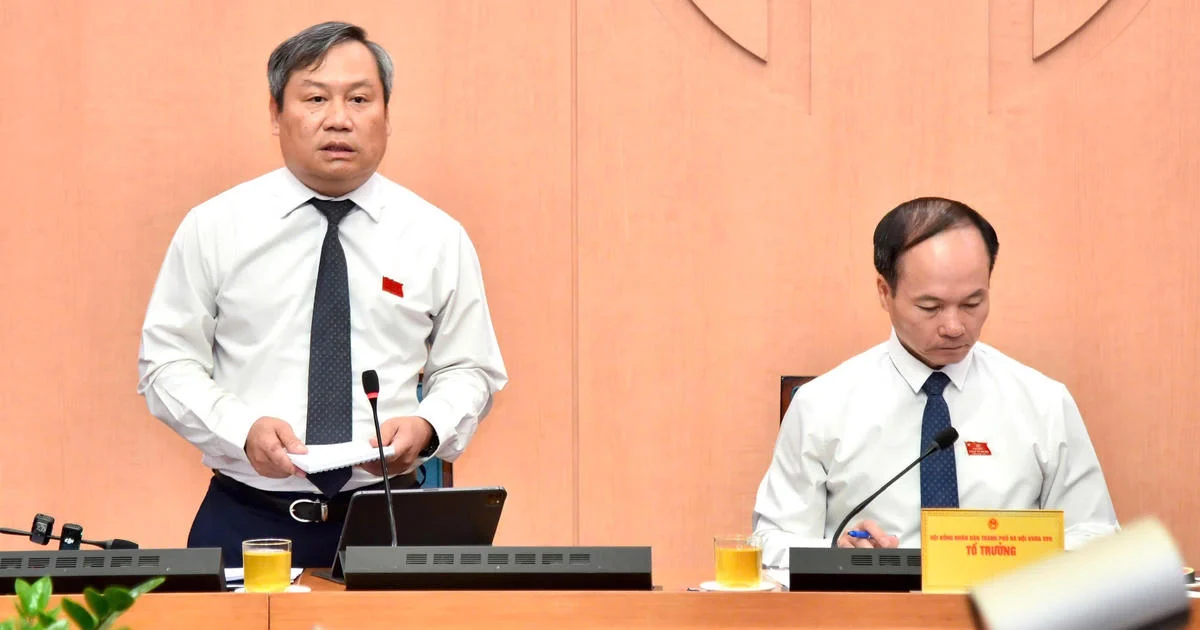

Speaking at the meeting, Chairman of the Hanoi People’s Committee Vu Dai Thang stated that although the time since the Law on the Capital City was passed has not been long, the Hanoi People’s Committee – the agency in charge of drafting the resolutions – has made maximum efforts to develop the contents of the Law that need to be concretized by the City People’s Council resolutions, ensuring that they are submitted to the City People’s Council for approval before June 15th. At this session, many resolutions concretizing the 2026 Law on the Capital City in 5 areas were submitted to the City People’s Council.
Hanoi People’s Committee Chairman Vu Dai Thang emphasized that the 2026 Law on the Capital City represents fundamental changes compared to the two previous Laws on the Capital City.
“This law is a framework law, shaping the comprehensive decentralization, delegation of power, and authorization of Hanoi City in deciding on issues within the capital city; even issues of inter-regional and inter-provincial significance within the Capital Region. With that spirit, the Hanoi City People’s Council is shifting from a policy-implementing role to a policy-making and policy-implementing role,” the Chairman of the Hanoi People’s Committee emphasized.
The Chairman of the Hanoi People’s Committee stated that, given its new role, the development of resolutions guiding the implementation of the 2026 Law on the Capital City is of particular importance, ensuring both consistency and continuity, while preventing the risk of abuse of power in its implementation. Therefore, in recent times, Hanoi has focused intensely on developing policies to implement the Law on the Capital City, ensuring that the processes and procedures are democratic and objective.
Notably, the Capital City Law of 2026, effective from July 1st, will be consistent with other important foundations such as Resolution No. 02-NQ/TW, dated March 17, 2026, of the Politburo on building and developing Hanoi in the new era and the 100-year vision Capital City Planning approved by the Hanoi People’s Council. This will provide a comprehensive legal basis for Hanoi to implement its development goals, focusing on building a “Cultural – Civilized – Modern” capital city, achieving sustainable development, and improving the quality of life for its people.
Besides specifying the Law on the Capital City, Chairman of the Hanoi People’s Committee Vu Dai Thang said that the process of developing these policies is also integrated with the Central Government’s strategic resolutions in the fields of science and technology, health, education, and culture and social affairs .
Many of the contents are integrated with the Hanoi City Party Committee’s policies on science and technology development, innovation, and digital transformation; and are linked to the development orientation of education, health, and culture in Hanoi in the coming period. The goal is to both concretize the Law on the Capital City and create a foundation for the synchronous development of education, health, culture, and science and technology in the city.
A notable highlight in the resolutions presented this time is the goal of administrative procedure reform at a level higher than the general requirements of the Central Government. According to the Chairman of the Hanoi People’s Committee, Vu Dai Thang, while the Prime Minister requested a reduction of approximately 30% in administrative procedures, time, and costs, Hanoi has set a higher target thanks to special mechanisms from the Law on the Capital City.
“During the process of guiding and implementing the Capital City Law, Hanoi strives to reduce the number of administrative procedures by 50%; the time required to complete administrative procedures by 50%, and the cost of implementing administrative procedures by 50%,” informed Chairman of the Hanoi People’s Committee Vu Dai Thang.
Citing the Resolution on adjusting administrative procedures in the field of business registration in Hanoi (implementing point a, clause 2, Article 8 of the Law on the Capital City), the Chairman of Hanoi stated that Hanoi aims to become a locality with a transparent and strong environment in encouraging business development and developing the business ecosystem, with the goal of having approximately 700,000 to 800,000 businesses by 2030, double the current number.
Along with administrative procedure reforms, the spirit of decentralization and delegation of power is also clearly reflected in resolutions related to urban management and public security.
According to Chairman of the Hanoi People’s Committee Vu Dai Thang, in addition to the resolutions presented at this session, approximately 39 other resolutions detailing the 2026 Law on the Capital City will be presented at the next session after consultations with central ministries and agencies are completed.
According to the plan, after the Hanoi People’s Council approves the resolution, Hanoi will spend about two weeks organizing guidance on its implementation in communes, wards, and affiliated agencies, ensuring that from July 1st, the effective date of the Capital City Law, all resolutions of the Hanoi People’s Council will be implemented synchronously.
Source: https://baophapluat.vn/ha-noi-phan-dau-cat-giam-50-so-thu-tuc-thoi-gian-va-chi-phi-thuc-hien-thu-tuc-hanh-chinh.html